

At any given moment, an estimated 2,000 thunderstorms are in progress around the world in various locations. Although they are most frequent in the tropics, they can occur just about anywhere on the planet. They are more likely to happen in summer when the two elements they require, moisture and rising warm air, are prevalent.
In humid regions, in particular, a warm temperature and high humidity will create a large amount of warm, moist air. This can quickly turn into a thunderstorm, as it rises into the atmosphere. We recognise a storm is on the way when we hear thunder, which enables us to estimate how far away the lightning is.
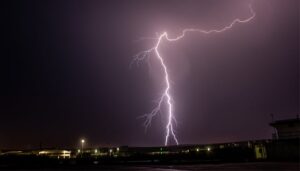
© sam-whitfield1 / Shutterstock.com
This is made possible because we see lightning immediately, but it takes the sound of thunder around five seconds to travel a mile. Count the number of seconds between the sound of thunder and the flash of lightning and then divide it by five. If you count five seconds, the lightning is one mile away; 15 seconds it’s three miles away and so on.
Chances are, if you hear thunder, you’re probably within striking distance of the storm, so it’s best to try and get indoors before it arrives. Between 30 and 60 people in the UK are struck by lightning every year and sadly, between 5% and 10% of these strikes prove fatal. Most victims suffer burn injuries.
How is lightning created?
Lightning is created when a thundercloud becomes full of frozen raindrops. These become small pieces of ice, which bump into each other as they move around in the air. These continual collisions create an electrical charge.
Soon, the cloud will fill up with electrical charges. Positive charges (protons) collect at the top of the cloud and negative charges (electrons) drop to the bottom. A positive charge then starts to build up below the cloud on the ground.
Electrical charges are attracted to any protruding object around them including trees, telephone masts, buildings and people. Lightning can strike in an instant, when an electrical charge reaches down from the cloud and connects with the charge shooting up through the protruding object.
Lightning is a huge electrical spark. A bolt of lightning is very hot – it can heat the air surrounding it to five times hotter than the sun’s surface and produce over 100 million volts. The average lightning flash could light a 100-watt light bulb for three months!
The two most common types of lightning are forked lightning, when many luminous “branches” are visible from the main channel; and sheet lightning, when the emitted light seems to diffuse, with the apparent absence of a main channel because it is obscured by the cloud.
Most thunderstorms are experienced on the island of Java in Indonesia, where they occur around 220 days each year. In the UK, the number of thunderstorms per year varies, depending on where in the country you live.
In some regions, such as western coastal districts and in central and northern Scotland, there are very few thunderstorms. Usually, there are only five per year in these regions. However, in the East Midlands and in parts of southeast England, there can be storms on 15 to 20 days per year. Summer is the most thundery season in the UK.
Is global warming making the situation worse?
Global warming appears to be worsening the situation and we’re likely to see more and more thunderstorms as years go by, as a result of climate change. Experts are warning of a “dramatic increase” in lightning. In fact, the amount of lightning is set to rise by 12% for every 1°C temperature rise.
As temperatures are estimated to be around 4°C higher by the end of the 21st century, this could potentially mean lightning strikes will increase by 50% by 2100, causing more injuries, damage and fires.
Thunderstorms can be dangerous, not only because a lightning strike can cause death and injury, but also because it can destroy property or cause a fire. In addition, a storm is often accompanied by increased rainfall and this can cause flooding.
Flash floods may occur, when rivers or streams burst their banks, causing damage to the surrounding area and any properties in their wake. Insurance claims for lightning strikes can vary in severity. Sometimes, a property’s central electrical system can be severely damaged, destroying electrical equipment such as TV sets and CCTV equipment.
If the lightning causes a fire within the home, this can have a devastating effect, destroying furniture, fixtures and fittings. Severe damage can also occur if the lightning is part of a major storm that causes flooding.
Where have severe storms occurred in the UK?
In June 2020, severe storms struck much of Wales. More than one month’s rain fell in two hours, with continual thunder and lightning, particularly across the Brecon Beacons. Lightning struck the television aerial of one house in Gowerton, Swansea, causing a serious fire that required firefighters to extinguish it.
When there are clusters of thunderstorms, the average UK insurer receives around 200 claims a month for damage caused by lightning. This was the case in June 2016, when continual heavy storms led to a massive surge in insurance claims, with severe damage caused to buildings, electrical systems and furniture nationwide.
The most severe cases can cost up to around £45,000 to resolve if expensive electrical equipment throughout the house is damaged by a direct lightning strike.
If there is thunder and lightning, help prevent damage to your home by taking a few simple steps, such as turning off the electricity. If you can’t turn off your supply altogether until the storm passes, avoid touching anything electronic that is plugged into the mains. Unplug your devices altogether if possible.
If lightning strikes your house, it can follow the phone lines or electrical wiring, causing a massive power surge to the circuits that can ruin TV sets, gaming consoles and any other electrical items that are plugged in.
Should your home be struck by lightning, Furniture Rental Online can help provide support with our emergency furniture rental packages. We can also assist loss adjusters and insurance companies with claims.
If you need our help now or even sometime in the future contact us.